

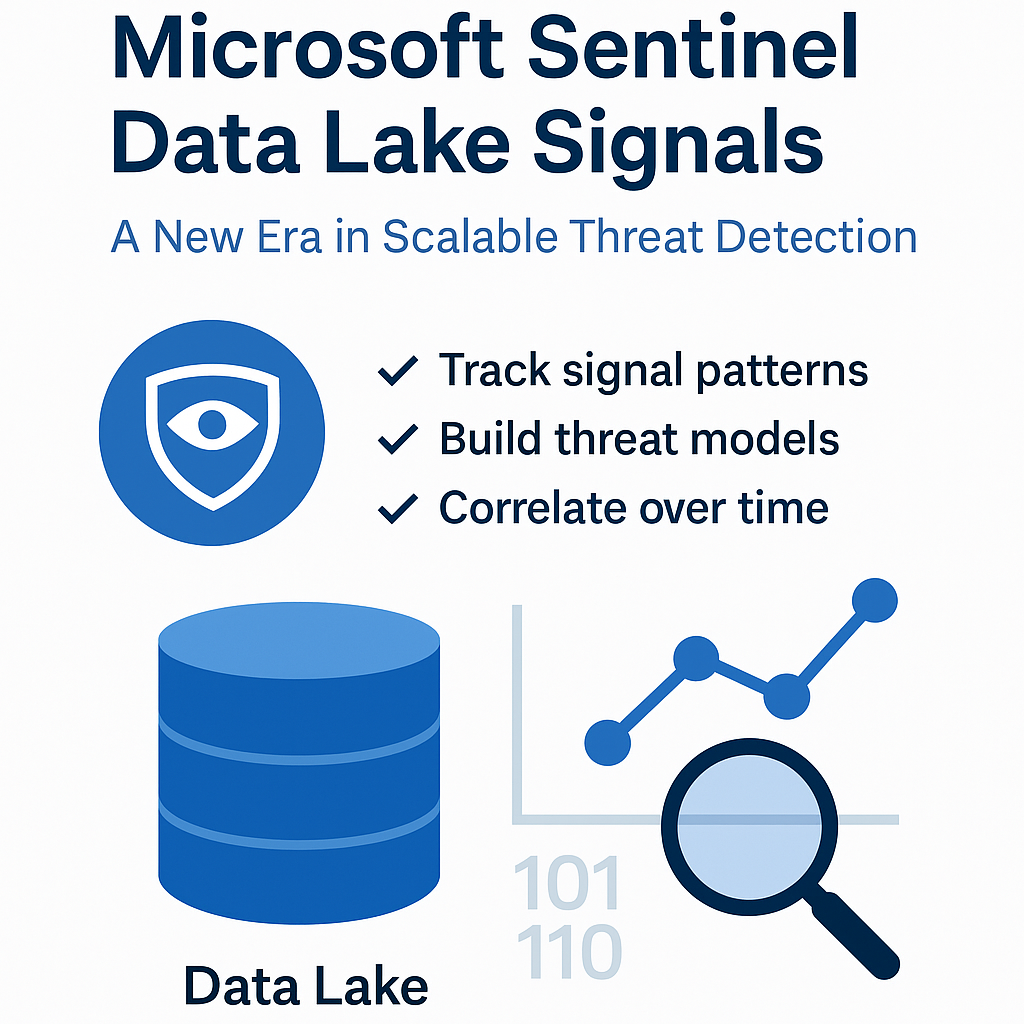
Unlocking the Power of Microsoft Sentinel Data Lake Signals
A new era in scalable threat detection
🔍 What Are Data Lake Signals?
Microsoft Sentinel’s Data Lake Signals allow organisations to persist signals, detections, and threat indicators
directly into their Log Analytics workspace or Azure Data Lake. This enables security teams to retain stateful
risk indicators over time and build layered threat models beyond incident-driven alerts.
🧠 Why Is This a Game-Changer?
Unlike traditional SIEM alerts that react to isolated events, Data Lake Signals empower you to build memory into your
detection logic. You can now track behavior patterns across time, users, and assets—even when no individual alert is triggered.
- Stateful detection logic
- Custom signal tracking
- Signal chaining across entities
- Efficient suppression and prioritisation
Use Case: Detecting Lateral Movement Attempts
Persist signals like RDP login attempts and correlate them across time windows. Trigger alerts only when patterns emerge,
such as multi-host access across days—ideal for catching low-and-slow threats.
⚙️ How Does It Work?
Custom KQL rules can be written to output to a new SecuritySignal table in Log Analytics.
These persisted signals can then be queried or used in new detection rules that consider historical behavior.
🏗️ Building a Layered Detection Framework
Think of it as combining short-term memory (real-time alerts) with long-term memory (stored signals). For example:
- Step 1: Suspicious login → Persist signal
- Step 2: Abnormal data access → Correlate
- Step 3: Combine signals → Trigger alert
🔐 Final Thoughts
Data Lake Signals represents a shift from reactive security to intelligent detection. It reduces false positives, supports advanced use cases,
and enhances SOC capabilities—especially in hybrid or cloud-native environments.
💬 Let’s Talk
Are you leveraging Data Lake Signals in your Sentinel deployment? Let’s connect and discuss use cases, architecture, or detection strategy ideas.